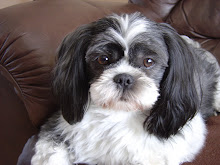
I do not know who the author of this story is, or how long it has been around. It was sent to my dad as an email. He read it to me and I knew I just had to include it as a post on my blog. It is a great story…and according to all the research I have done…it is just that, a story. Snopes claims that it is 97% certain that there is no truth to the story, but that it does show the sacrifices that members of the military have to make when they are sent off to war. So, as a tribute to their sacrifices so that all of us can live in freedom and “do our own thing,” here is the “Story of Reggie.”
"They told me the big black Lab's name was Reggie as I looked at him lying in his pen. The shelter was clean, no-kill and the people really friendly. I'd only been in the area for six months, but everywhere I went in the small college town, people were welcoming and open. Everyone waves when you pass them on the street.
But something was still missing as I attempted to settle in to my new life here and I thought a dog couldn't hurt. Give me someone to talk to. And I had just seen Reggie's advertisement on the local news. The shelter said they had received numerous calls right after, but they said the people who had come down to see him just didn't look like "Lab people," whatever that meant. They must've thought I did.
But at first, I thought the shelter had misjudged me in giving me Reggie and his things, which consisted of a dog pad, bag of toys almost all of which were brand new tennis balls, his dishes and a sealed letter from his previous owner. See, Reggie and I didn't really hit it off when we got home. We struggled for two weeks (which is how long the shelter told me to give him to adjust to his new home). Maybe it was the fact that I was trying to adjust, too. Maybe we were too much alike.
For some reason, his stuff (except for the tennis balls - he wouldn't go anywhere without two stuffed in his mouth) got tossed in with all of my other unpacked boxes. I guess I didn't really think he'd need all his old stuff, that I'd get him new things once he settled in, but it became pretty clear pretty soon that he wasn't going to.
I tried the normal commands the shelter told me he knew, ones like "sit" and "stay" and "come" and "heel" and he'd follow them - when he felt like it.
He never really seemed to listen when I called his name - sure, he'd look in my direction after the fourth of fifth time I said it, but then he'd just go back to doing whatever. When I'd ask again, you could almost see him sigh and then grudgingly obey.
This just wasn't going to work. He chewed a couple shoes and some unpacked boxes. I was a little too stern with him and he resented it, I could tell. The friction got so bad that I couldn't wait for the two weeks to be up and when it was, I was in full-on search mode for my cell phone amid all of my unpacked stuff. I remembered leaving it on the stack of boxes for the guest room, but I also mumbled, rather cynically, that the "damn dog probably hid it on me."
Finally I found it, but before I could punch up the shelter's number, I also found his pad and other toys from the shelter.. I tossed the pad in Reggie's direction and he snuffed it and wagged, some of the most enthusiasm I'd seen since bringing him home. But then I called, "Hey, Reggie, you like that? Come here and I'll give you a treat." Instead, he sort of glanced in my direction - maybe "glared" is more accurate - and then gave a discontented sigh and flopped down. With his back to me.
Well, that's not going to do it either, I thought. And I punched the shelter phone number.
But I hung up when I saw the sealed envelope. I had completely forgotten about that, too. "Okay, Reggie," I said out loud, "let's see if your previous owner has any advice."....
To Whoever Gets My Dog:
Well, I can't say that I'm happy you're reading this, a letter I told the shelter could only be opened by Reggie's new owner. I'm not even happy writing it. If you're reading this, it means I just got back from my last car ride with my Lab after dropping him off at the shelter. He knew something was different. I have packed up his pad and toys before and set them by the back door before a trip, but this time...it's like he knew something was wrong. And something is wrong... which is why I have to go to try to make it right.
So let me tell you about my Lab in the hopes that it will help you bond with him and he with you.
First, he loves tennis balls. The more the merrier. Sometimes I think he's part squirrel, the way he hordes them. He usually always has two in his mouth, and he tries to get a third in there. Hasn't done it yet. Doesn't matter where you throw it, he'll bound after it, so be careful - really - don't do it by any roads. I made that mistake once and it almost cost him dearly.
Next, commands. Maybe the shelter staff already told you, but I'll go over them again: Reggie knows the obvious ones - "sit," "stay," "come," "heel." He knows hand signals: "back" to turn around and go back when you put your hand straight up; and "over" if you put your hand out right or left. "Shake" for shaking water off, and "paw" for a high-five. He does "down" when he feels like lying down - I bet you could work on that with him some more. He knows "ball" and "food" and "bone" and "treat" like nobody's business.
I trained Reggie with small food treats. Nothing opens his ears like little pieces of hot dog.
Feeding schedule: twice a day, once about seven in the morning and again at six in the evening. Regular store-bought stuff; the shelter has the brand.
He's up on his shots. Call the clinic on 9th Street and update his info with yours; they'll make sure to send you reminders for when he's due. Be forewarned: Reggie hates the vet. Good luck getting him in the car - I don't know how he knows when it's time to go to the vet, but he knows.
Finally, give him some time. I've never been married, so it's only been Reggie and me for his whole life. He's gone everywhere with me, so please include him on your daily car rides if you can. He sits well in the backseat and he doesn't bark or complain. He just loves to be around people and me most especially.
Which means that this transition is going to be hard, with him going to live with someone new.
And that's why I need to share one more bit of info with you....
His name's not Reggie.
I don't know what made me do it, but when I dropped him off at the shelter, I told them his name was Reggie. He's a smart dog, he'll get used to it and will respond to it, of that I have no doubt. But I just couldn't bear to give them his real name. For me to do that, it seemed so final, that handing him over to the shelter was as good as me admitting that I'd never see him again. And if I end up coming back, getting him and tearing up this letter, it means everything's fine. But if someone else is reading it, well...well it means that his new owner should know his real name. It'll help you bond with him. Who knows, maybe you'll even notice a change in his demeanour if he's been giving you problems. His real name is Tank.
Because that is what I drive.
Again, if you're reading this and you're from the area, maybe my name has been on the news. I told the shelter that they couldn't make "Reggie" available for adoption until they received word from my company commander. See, my parents are gone, I have no siblings, no one I could've left Tank with...and it was my only real request of the Army upon my deployment to Iraq , that they make one phone call to the shelter...in the "event"... to tell them that Tank could be put up for adoption. Luckily, my colonel is a dog guy, too and he knew where my platoon was headed. He said he'd do it personally. And if you're reading this, then he made good on his word.
Well, this letter is getting too downright depressing, even though, frankly, I'm just writing it for my dog. I couldn't imagine if I was writing it for a wife and kids and family. But still, Tank has been my family for the last six years, almost as long as the Army has been my family.
And now I hope and pray that you make him part of your family and that he will adjust and come to love you the same way he loved me.
That unconditional love from a dog is what I took with me to Iraq as an inspiration to do something selfless, to protect innocent people from those who would do terrible things... and to keep those terrible people from coming over here. If I had to give up Tank in order to do it, I am glad to have done so. He was my example of service and of love. I hope I honoured him by my service to my country and comrades.
All right, that's enough. I deploy this evening and have to drop this letter off at the shelter. I don't think I'll say another good-bye to Tank, though. I cried too much the first time. Maybe I'll peek in on him and see if he finally got that third tennis ball in his mouth.
Good luck with Tank. Give him a good home and give him an extra kiss goodnight - every night - from me.
Thank you,
Paul Mallory
I folded the letter and slipped it back into the envelope. Sure I had heard of Paul Mallory, everyone in town knew him, even new people like me. Local kid, killed in Iraq a few months ago and posthumously earning the Silver Star when he gave his life to save three buddies.. Flags had been at half-mast all summer.
I leaned forward in my chair and rested my elbows on my knees, staring at the dog.
"Hey, Tank," I said quietly.
The dog's head whipped up, his ears cocked and his eyes bright..
"C'mere boy."
He was instantly on his feet, his nails clicking on the hardwood floor. He sat in front of me, his head tilted, searching for the name he hadn't heard in months.
"Tank," I whispered.
His tail swished. I kept whispering his name, over and over and each time, his ears lowered, his eyes softened and his posture relaxed as a wave of contentment just seemed to flood him. I stroked his ears, rubbed his shoulders, buried my face into his scruff and hugged him.
"It's me now, Tank, just you and me. Your old pal gave you to me." Tank reached up and licked my cheek. "So whatdaya say we play some ball? His ears perked again. "Yeah? Ball? You like that? Ball?" Tank tore from my hands and disappeared into the next room. And when he came back, he had three tennis balls in his mouth."
I hope you enjoyed the story and that it brought a lump to your throat and a tear to your eye. It did for me!
Thank you to all the men and women of the Military who keep us safe and free.
Until next time,
Teia
PS. Today’s Grandma’s 89th Birthday…Happy Birthday Grandma!